Tuesday, September 29, 2015

STARTER LOFT 4 (continued)


Step Nine

Now lets finish off the aviary.  First install a 1X4 along the loft front from the 1X4s you installed on the aviary sides, once again by screwing through the OSB from the inside into the 1X4.  Cut out the vertical trim all ready installed. After you have done this cut a hole in the wall for your trap.  The size is up to you.  I make mine 19 by 12 inches because that is the size of my electronic sensors for my clock.  see below.


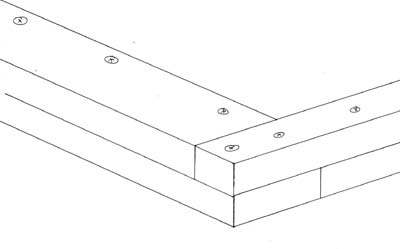
Now add a second 1X4 to the front of the aviary floor.  Measure the distance between the front 1X4 you just installed and the back 1X4 installed on the wall and cut three pieces of 1X4 this length.  Install them front to back between the two long 1X4s on two foot centers.  Like this.


Now all you need to do here is add your wire to the 1X4s.  I like using 1X1 inch welded wire.  At a lot of hardware stores or farm stores you can buy it in 3 foot wide rolls or by the foot.  Be sure and triangulate from opposite corners to square up your framing before stapling on the wire.  OK, now lets build the aviary front.


Start by ripping 3 or 4 1X4s in half.  Take a 1X4 and lay it on the aviary floor, it will need to be cut.  You need space for it to open and close.  You will need to cut about 1/2 to 3/4 off all the long pieces for the aviary front.  When this front is finished you want about 3/8 inch gap on each side.  After cutting your long pieces lay out one 1X4 and one 1X2 crossways on a flat surface with five 1X2s running up and down like the drawing below. Outside width about 95 and 1/4 inches, outside height 48 inches.   Measure corner to corner to square it up.  Then from your 24" wide roll of 1/2 by1/2 screen cut four pieces 46" long.  Staple each piece in position on the aviary front.  Be careful as these pieces are not held together by anything yet. If you have a wooden deck or an extra piece of OSB this frame can be temporary screwed to it to hold it in place as your stapling on the screen.


Once you have all four pieces of screen stapled onto your aviary frame attach a second layer of the 1X2s and 1X4s on top of the first layer.  Screw this second layer to the first with your short sheet rock screws every 6 inches.  Be sure and remove your temporary hold down screws as you go.  And make the joints of the second layer opposite the joints of the first layer, like this.  Also when you screw the two 1X4 pieces together put all the screws along the inside edge of the 1X4 as we will be cutting this end at a 45 and you don't want any screws in the blade path.


Once this done flip your aviary front over and screw it together from the other side, 6" spacing again.  And you thought 5lbs of screws were to much.  Have you bought your second box yet?  When that is done make a 45 degree saw cut  from the bottom corner of the 1X4 side the full length of the aviary front.  Watch out for screws.  Cut it like this.


Now attach 4 hinges to the bottom of the aviary front, set the aviary front in place and finish attaching the hinges.  Put a metal gate handle on the center 1X2 and your ready to go.


The aviary front should rest on the ground at about a 45 degree angle when open.  If yours does not hit the ground you can set a couple of blocks under the corners to support the front when open.


continue http://americanracingpigeonunion.blogspot.com/2015/09/starter-loft-5-finis.html


STARTER LOFT 5 (finis)


Finishing Touches

Most of you will want to paint your new loft now, before you start adding perches or nest boxes.  The OSB will not stand up to a lot of bad weather.  I hate painting, so what I do is put on my coveralls, put a paper bag on my head with two eye holes, wear a respirator, fire up my airless sprayer, and anything that doesn't move gets it!  It usually takes two coats.  You can use paint or just a good water proofing like "Thompson's". 

Also you still need to add a door handle.  I use a screen door handle.  You can get them from the hardware store for about $6 or $9 for one with a lock set.  


Outside of screen door handle.


Inside of screen door handle.

 And you need to add a door for your trap.  Make the door some what bigger than the hole.  There are all sorts of ways to latch the door up or slightly open.  This is how I do it.


Trap latched open.

Trap set in Race position.

Trap closed.
 And here are some assorted pictures of my loft.


Aviary front showing saw cut and joint.


Aviary front hinge placement.

Handle on Aviary front.

This photo shows the roof trim.

Door trim installed against the hinge.

This is the stop for the Aviary front.

My adjustable vent doors.

Note rope going up to aviary bottom.

Happy birds!


Do you need more information?  Don't hesitate to contact us at 1-800-755-2778 or 1-405-848-5801.

American Racing Pigeon Union

Friday, September 11, 2015

PROMOTE YOUR SPORT THROUGH RACE RESULTS


AU member, Doug Harms, shared the following promotion idea with us.  It has worked well to improve awareness of the hobby and contacts, and it is something that people can see in their newspaper on a weekly basis without the fee of advertising.

If your club is not doing this, perhaps you will consider it as a future promotion tool.

Would you like to help get more members in your local Pigeon Club?????

Go to your local newspaper and ask if they will publish the race results for your local pigeon races, at no cost to your club.

Give them this "example" of what they might expect you to send in each week.

" Sterling- The results are in for the Rock River Valley Racing Pigeon Club's 200 mile race on 8/23/15.  

  The winner of the A Race is Doug Harms, of Rock Falls, at 1087.9 yards per minute or 37.1 miles per hour.  Second loft is Devoe Manning, of Dixon, at 1012.6 ypm or 34.5 mph.  Third loft is Pat and Don Kelsey, of Sterling, at 950.9 ypm or 32.4 mph.

  The winner of the B Race is Steve Calsyn, of Rock Falls,  at 933.0 ypm or 31.8 mph.  Second loft is Jake Scroggins, of Sterling, at 802.0 ypm or 27.3 mph.  Third loft is Cathy and Al Esgar, of Dixon, at 697.6 ypm or 23.8 mph.  To view complete race results go to rrvpigeonclub.org   To join in this fun sport, call Devoe Manning at 779-861-1830 or Doug Harms at 815-535-5205."

Your local newspaper will want this to be done right the first time, so be sure to proof read twice, before you hit the send tab on your computer.

Note the race results in the "example" are given in yards per minute and miles per hour.  This is done because the public can better identify with miles per hour.  An easy way to convert the yards per minute to miles per hour is to multiply the yards per minute by 60, then divide your answer by 1760.  Example:  1320 ypm times 60 = 79,200 divided by 1760 = 45 mph. 

Note in "example" the words "yards per minute" and "miles per hour" are spelled out only the first time; after that, you can use the abbreviation, "ypm" and "mph" to save on space for your local newspaper.

Note in "example" that you will want to list the winner and what town he is from, and then list 2nd loft and 3rd loft.  This will put more local names into the results that people will recognize.

Note in "example" at the finish of the report you will direct the public to your club website.  You will tell them that the sport is fun and you will tell them who to contact to join in this fun sport.

Most papers will publish your race results for free in the sports pages or maybe in the business section of the paper.  In either place, you are getting the job done at no cost.

I send the race results to our local paper each week.  It takes me less than a half hour per week to accomplish this. 

The hope is that when other people see the race results, some people will want to inquire and hopefully join in the sport of racing pigeons.

Doug Harms, "Harms Loft" of GrayfoxHarms.com

Thank you Doug for an excellent idea!